



ESSENTIAL NOTES ON ‘GREAT MUSHROOM OF THE SUN’
Sun Mushroom (Agaricus blazei Murill) is renowned for its rich profile of active biomolecules, including functional beta-glucans (polysaccharides) and key essential minerals such as zinc. These bioactive compounds make this species a subject of significant interest within nutraceutical research.
Discovery and Global Interest in Brazil
Interest in the Sun Mushroom expanded significantly following field observations in the mountainous regions of São Paulo, Brazil, where local populations had long integrated the fungus into their daily diets. Subsequent scientific literature published during the 2000s highlighted the unique nutritional density and composition of wild populations.
These findings prompted international research teams to investigate its chemical composition and bioactive potential. As global awareness grew, controlled cultivation techniques were developed to meet international demand for standardised, high-quality Agaricus blazei biomass and extracts.

DOCUMENTED USES OF THE SUN MUSHROOM
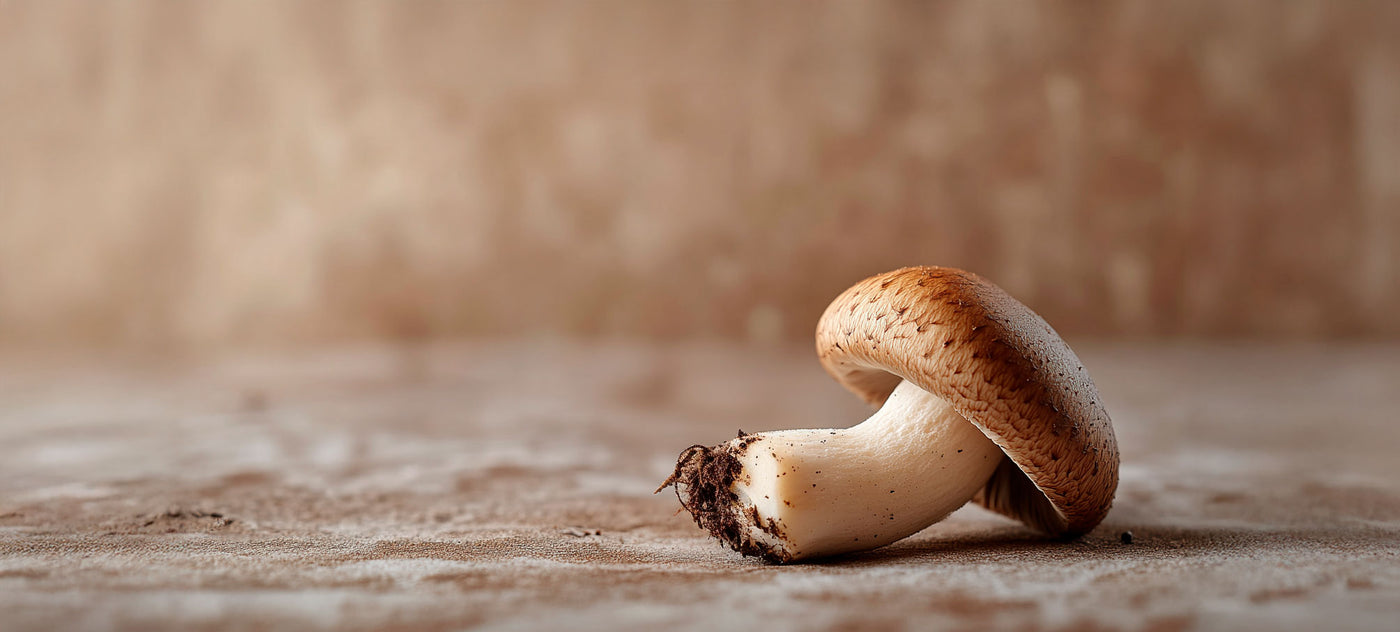
Alongside species such as Reishi and Lion's Mane, the Sun Mushroom has long been valued in dietary traditions for its exceptional profile of natural biomolecules. While it can be cooked similarly to button mushrooms or chanterelles, the Sun Mushroom features white, slightly fibrous flesh and is celebrated by culinary enthusiasts for its distinct almond-like aroma and flavour—earning it the popular name "almond mushroom".
High Concentrations of Active Biomolecules
While fresh culinary preparation is popular, concentrated extracts represent the most effective format for obtaining standardised amounts of its active biomolecules. Pure extracts provide the highest density of Sun Mushroom bioactive compounds, available in single-species organic capsule formulas such as Mico-Sol or synergistically combined in Mico-Five. It is also featured in liquid form within our children's range in Dr. Immune Five.
Hifas da Terra utilises green extraction technologies that preserve the natural integrity of delicate compounds without heat degradation, resulting in higher bioavailability and consistent batch-to-batch standardisation.
Products with sun mushroom
-

 TRENDINGHasta - 10 %
Dr. Immune Five Syrup (Reishi, Agaricus, Oyster, Chaga, Shiitake)
CHILDREN'S IMMUNE SYSTEMS SUPPORT
From 30,00 €Unit price /Unavailable -

 TOP SELLERSHasta - 10 %
Mico Five (Chaga, Reishi, Maitake, Shiitake, Sun mushroom) Capsules
IMMUNE SYSTEM SUPPORT
From 50,00 €Unit price /Unavailable -


SUN MUSHROOM CULTIVATION
Agaricus blazei, like other members of the genus Agaricus, can be cultivated on composted agricultural substrates derived from plant material, organic manure, and trace minerals, which undergo rigorous pasteurisation or heat sterilisation prior to inoculation. However, when production prioritises sustainability, batch consistency, and environmental stewardship, advanced Controlled Environment Agriculture (CEA) systems utilizing certified organic substrates and precision climate management are employed.
Featured Biomolecules
This species contains active biomolecules, including:


Do you want to know more?
Habitat and distribution
Habitat and distribution
This fungus grows as a saprophyte (an organism that feeds on decomposing organic material), colonising the nutrient-rich organic soil of forest floors. In its natural habitat, average temperatures hover around 25°C, where seasonal rainfall creates a warm, humid microclimate. Ideal growth requires these specific warm and moist conditions characteristic of its native region in Brazil, where ambient temperatures range from daytime highs of 35°C to nighttime lows of 22°C. It is also native to sub-tropical regions in the south-eastern United States, such as Florida and Louisiana.
Since the 1980s, cultivation of this species has expanded into other geographical regions utilising specialized growing protocols tailored to specific production goals. Today, the Sun Mushroom holds significant commercial importance globally, with cultivation established across the Americas, Asia, and select European centers.
Mycological notes
Mycological notes
The taxonomic history of the Sun Mushroom is rich and complex. In 1893, the species was first described scientifically in the United States by Charles Horton Peck as Agaricus subrufescens. Decades later, in 1947, the American mycologist Dr. William Alphonso Murrill redescribed the species under the name Agaricus blazei. Concurrently, the mushroom was widely known in South America as the "almond mushroom" of Brazil (Agaricus brasiliensis), though it was initially believed that these represented three distinct species.
Detailed genetic sequencing and comparative studies conducted in 2002 by researchers Wasser, Didukh, and Kerrigan demonstrated that these taxa are scientifically identical. While Agaricus subrufescens Peck remains the oldest valid taxonomic name, Agaricus blazei Murrill remains widely recognized across industry and research contexts.
Interestingly, commercial cultivation of the Brazilian strain was first pioneered by a Japanese mycologist residing in Brazil during the 1960s, paving the way for its widespread cultivation across Asia from the 1980s onward. Visually, Agaricus subrufescens produces a fleshy fruiting body with a cap reaching up to 12 cm in diameter, characterized by a golden-brown cuticle, a convex shape, and dark brown gills.
The culture in bioreactors
The culture in bioreactors
Quality, Purity, and Consistency in Our Production Systems
Our commitment to excellence is reflected in our strict quality assurance standards, ensuring purity and consistent quality across our products.
R&D and Sun Mushroom Studies
R&D and Sun Mushroom Studies
- Hifas Da Terra conducts studies to improve fungus production processes and optimize the development of new biotechnological base ingredients
- Hifas da Terra has, in its wide mycoteca (Micological Bank Hifas), its own strains isolated from the Iberian Peninsula that selects for the development of its formulas
- Hifas da Terra develops multiple studies in collaboration with research centers and universities.
Curiosities
Curiosities
- Sun mushroom, unlike other species that prefer semi -shade, can grow directly to the sun.