


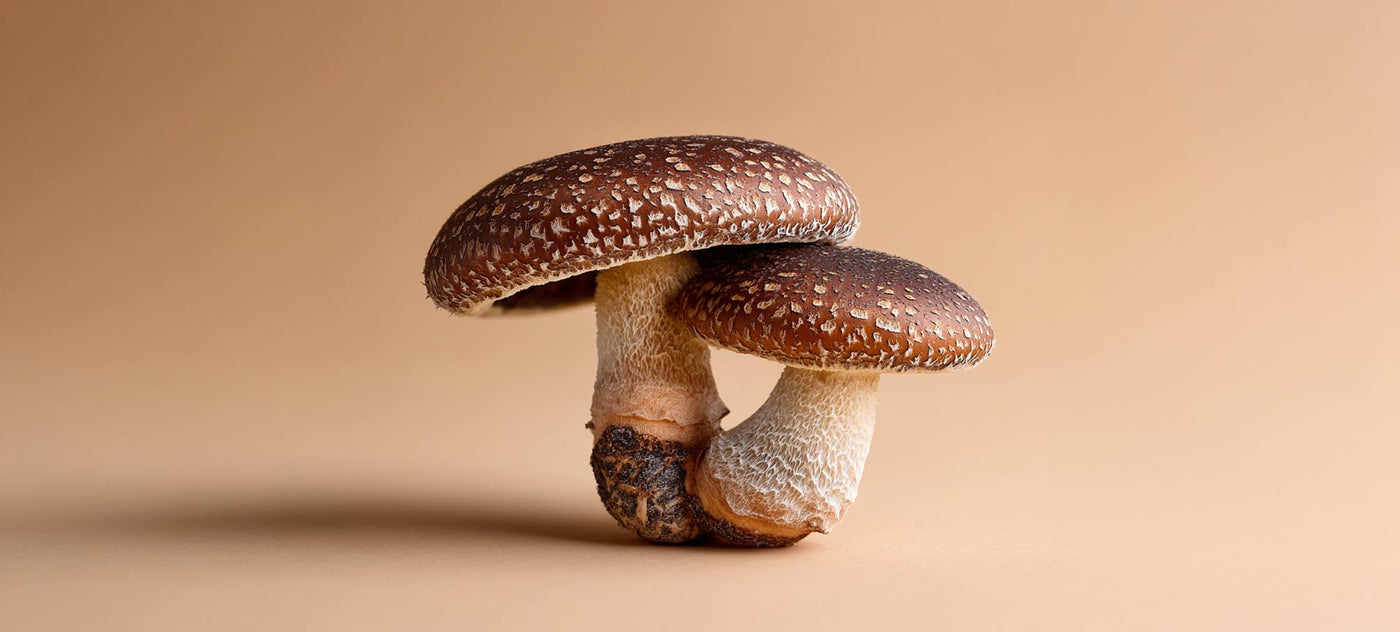

ESSENTIAL NOTES ON THE “FOREST MUSHROOM”
Like Reishi and Maitake has been featured in many publications on scientific websites. Today, medical institutions such as the New York Academy of Science and universities in Japan, China, the United States, the United Kingdom, Germany, Sweden, etc. have documented studies on this mushroom. Furthermore, the results of these investigations have been published in internationally renowned scientific journals. Lentinus is an excellent and delicious edible mushroom, highly prized in China and Japan. In addition, its qualities have been valued since time immemorial in Eastern cultures. From a nutritional point of view, it contains provitamin D, unsaturated fatty acids and large amounts of polysaccharides, especially lentinan or lentinane.

DOCUMENTED USES OF SHIITAKE
In addition to its culinary heritage, Lentinula edodes is highly valued for its distinct culinary aroma, rich texture, and exceptional organoleptic qualities.
Which Format Delivers the Highest Concentration of Shiitake Biomolecules?
The highest concentration of active biomolecules is found in standardised powder extracts, produced using clean, green extraction technologies that concentrate delicate compounds without heat degradation. For flexible dosing, liquid extract formulations such as Dr. Immune Five allow intake to be precisely optimised to fulfil specific nutritional requirements.
Synergistic multi-species formulas also frequently incorporate Shiitake extract. It is combined alongside Reishi and Maitake in Mico-Mix, and alongside Reishi, Maitake, Sun Mushroom, Cordyceps, and Chaga in Mico-Five.
An intermediate format between culinary consumption and highly concentrated extract capsules is 100% micronised Shiitake powder. This full-spectrum biomass is featured in targeted digestive health blends such as Bio-Intestin and Hifas-Microbiota.
Products with Shiitake
-

 TOP SELLERSHasta - 10 %
HIFAS-Microbiota (Lion’s Mane, Oyster, Reishi, Shiitake) capsules
GUT COMFORT SUPPORT
From 42,50 €Unit price /Unavailable -


Mico Mix (Shiitake, Reishi, Maitake) Capsules
REISHI, MAITAKE & SHIITAKE
60,00 €Unit price /Unavailable


SHIITAKE CULTIVATION
As a saprophytic species, Shiitake primarily colonises timber and hardwood by-products such as sawdust, wood chips, or bark. While Shiitake reproduces via airborne spores in nature, spore propagation is unsuited to commercial cultivation where batch consistency and high yields are essential. Instead, standardized cultivation protocols utilize sterilized plug or grain spawn to inoculate hardwood logs or compressed sawdust blocks with pure mycelium, ensuring biomass remains completely free from competitive moulds and unwanted bacterial contamination.
FEATURED BIOMOLECULES
Fresh or dried shiitake mushrooms are usually sold without the stem. Scientific studies have confirmed that both the cap and stem can be used to obtain nutraceuticals. Lentinula is a source of dietary fibre and other active biomolecules:


Do you want to know more?
Habitat and distribution
Habitat and distribution
The cultivation of this mushroom of Asian origin is one of the most widespread. It was originally cultivated exclusively in Eastern countries, but currently large productions are obtained both in Europe and the US., Where it has a great demand. Today, the Shiitake industry in Japan is in continuous expansion and enjoys good social reputation for its contribution to the defense of forests.
Mycological notes
Mycological notes
Lentinula edodes (Berk.) Pegler belongs to the order Agaricales and the family Omphalotaceae. Reclassified by British mycologist David Pegler in 1975, Lentinula edodes is the most economically significant species within the genus Lentinula. The botanical name derives from the Latin lentus (pliant or tough), inus (resembling), and the Greek edodes (edible).
The Fragrant Mushroom
Beyond its botanical designation, Lentinula edodes is widely known as the Forest Mushroom or Black Forest Mushroom. In China, it is popularly referred to as Xianggu (‘fragrant mushroom’) or Huagu (‘flower mushroom’), a name specifically applied to premium grades displaying a cracked, white-patterned cap (traditionally referred to as Donko in Japan).
Morphologically, Shiitake produces caps ranging from 5 to 25 cm in diameter with slightly turned-in, irregular margins. The underlying gills are white, developing faint reddish-brown tones as the fruiting body matures. The cap’s fibrous, dark brown cuticle features characteristic concentric scales that allow distinct commercial varieties to be identified. The stem is firm, fibrous, and centrally attached.
The culture in bioreactors
The culture in bioreactors
Quality, Purity, and Consistency in Our Production Systems
Our commitment to excellence is reflected in our strict quality assurance standards, ensuring purity and consistent quality across our products.
R&D and Shiitake studies
R&D and Shiitake studies
- Hifas da Terra conducts studies to improve fungus production processes and optimize the development of new biotechnological base ingredients
- Hifas da Terra has, in its wide mycoteca (Micological Bank Hifas), its own strains isolated from the Iberian Peninsula that selects for the development of its formulas
- Hifas da Terra develops multiple studies in collaboration with research centers and universities.
Curiosities
Curiosities
- Historical Cultivation: Widespread adoption of Shiitake cultivation expanded significantly during the Ming Dynasty (1368–1644) following the development and refinement of traditional hardwood log-inoculation techniques.
- Mythological Origins: According to ancient Chinese folklore, the mythical deity Shennong bestowed Shiitake and all functional fungi upon humanity over 5,000 years ago.
- Traditional Heritage: In rural tradition, timber logs were inoculated with Shiitake mycelium upon the birth of a child. As the child matured into adulthood alongside the growing crop, they would inherit the sustainable economic wealth generated by the harvest.